
Scope 3.6: Business travel
Learn how the Greenhouse Gas (GHG) Protocol defines Scope 3.6 emissions, how the protocol recommends calculating them and how they are actually calculated in Climate Reporting
How are Scope 3.6 emissions defined in the GHG Protocol?
Scope 3.6 covers indirect emissions from transporting employees for business purposes in vehicles owned or operated by third parties rather than by the reporting organisation. These emissions typically arise from air, rail, bus, and car travel, as well as other modes of transport, and companies may also include emissions from hotel stays during business trips.
A reporting company’s emissions from business travel therefore include the Scope 1 and Scope 2 emissions of the transportation providers involved (for example, airlines). The table below shows different types of employee travel-related activities and indicates which GHG scope each should be assigned to
| Activity | GHG scope category |
|---|---|
| Emissions from transportation in vehicles owned by the reporting company | Scope 1 (for vehicles that consume fuel) and Scope 2 (for vehicles that consume electricity |
| Emissions from the transportation of employees for business-related activities in vehicles owned by third parties | Scope 3.6 (Business travel) |
| Emissions from transportation of employees to and from work | Scope 3.7 (Employee commuting) |
| Emissions from leased vehicles operated by the reporting company not included in Scope 1 or Scope 2 | Scope 3.8 (Upstream leased assets) |
How does the GHG Protocol recommend calculating Scope 3.6 emissions?
Scope 3.6 emissions should, in line with the GHG Protocol, be calculated using either the fuel‑based or distance‑based methods (both a subset of activity-based methods) whenever the necessary data is available, and only default to the spend‑based method when such data cannot be obtained. All three methods follow the same basic approach of collecting relevant activity data (such as fuel consumption, distance travelled, or money spent) and applying appropriate emission factors to calculate emissions.
- Fuel-based method
- This method involves multiplying physical activity data (fuel use data from transport providers) with the emission factor of the fuel consumed (represented in grams or kilograms of CO2-equivalent per litre/kg of fuel).
- Possible activity data includes:
- Quantity of different fuels consumed OR
- Amount spent on different fuels together with their average prices OR
- Distance travelled by different vehicles along with their fuel efficiency
- Possible data sources can include:
- Aggregated fuel receipts
- Purchase records provided by transportation providers
- Internal transport and expense management systems
- Emission factors needed:
- Fuel emission factors, expressed in units of emissions per unit of energy consumed (e.g. kg CO2e/liter)
- For electric vehicles, electricity emission factors, expressed in units of emissions per unit of electricity consumed (e.g. kg CO2e/kWh)
- Distance-based method
- This method involves multiplying physical activity data (kilometers travelled by vehicle type) by distance-based emission factors (represented in grams or kilograms of CO2-equivalent per kilometer travelled).
- The distance-based method is especially useful for an organization that does not have access to fuel or mileage records from the transport companies.
- Possible activity data includes:
- Total distance travelled by each mode of transport for employees
- Optionally, countries of travel and specific types of vehicles used for travel
- Possible data sources can include:
- Automated tracking of distance travelled by mode through travel agency, transport providers, and expense management systems
- Online distance calculators
- Annual surveys/questionnaires of employees
- Working with travel providers to obtain data
- Emission factors needed:
- Emission factors for each mode of transport, expressed in kg CO2e emitted per kilometer or per passenger-kilometer travelled
- Spend-based method
- This method involves multiplying the amount spent on transportation by the relevant spend-based emission factor (expressed as grams or kilograms of CO2-equivalent per unit of currency).
- Possible activity data includes:
- Amount spent on transportation by type (rail, road, air) in local currency
- Possible data sources can include:
- Accounting systems, enterprise resource planning systems (ERP)
- Bills, invoices
- Emission factors needed:
- Cradle-to-gate emission factors of the transportation type per unit of economic value (e.g. kg CO2e/NOK)
- The spend-based method has high levels of uncertainty and is used when physical activity data is unavailable. The other two methods are recommended for business travel emissions.
How are Scope 3.6 emissions calculated in Climate Reporting?
In Climate Reporting, Scope 3.6 emissions are calculated using either the activity or spend-based method, depending on the user integrations. When integrated with an expense management system, detailed activity data can be extracted and combined with activity-based emission factors to calculate CO2-equivalents. If such system integration is unavailable, travel-related expenses are instead extracted from the company’s financial accounts and multiplied with appropriate spend-based emission factors to calculate CO2-equivalents.
What is an expense management system?
An expense management system (EMS) is a software that records, approves, and reimburses employee business expenses. It replaces manual processes (paper receipts, ad‑hoc spreadsheets, email approvals) with a digital workflow for capturing expenses, enforcing policy, routing approvals, and syncing to the accounting/ERP system.
EMS data is a particularly strong input for Scope 3.6, because it captures travel receipts, mileage claims, vendor names, dates, routes, and travel modes. This information turns ordinary monetary expense transactions into physical activity data that can be mapped to emission factors. Integrating an EMS therefore greatly improves the quality of Scope 3.6 emission calculations. The sections below describe how Scope 3.6 emissions are calculated in the app when an EMS is integrated and when it is not.
Calculation logic
If expense management system (EMS) is not integrated
- If an EMS is not integrated, Climate Reporting applies the spend‑based method. In this case, financial data (i.e. money spent on business travel) is extracted from the financial accounts.
- The accounts in which business travel transactions are recorded are identified, and the corresponding amounts are then aggregated by account and by month.
- Because emission factors are defined per transport type, these aggregated amounts must be allocated across the different modes of transport so that the correct emission factors can be applied.
- This allocation is based on a travel survey from SSB that reports the number of business trips by mode of transport for a given year.
- The total spend is distributed to the categories air, rail, road, water, and hotel stays, after which each portion is multiplied by the relevant emission factor (grams of CO₂e per NOK spent) and converted into kilograms of CO₂e emissions.
If expense management system (EMS) is integrated
- If an EMS integration is available, the system can access much more granular and higher‑quality activity data. Depending on which fields are available, it can then apply either the distance‑based or the spend‑based calculation method.
- All business travel transactions are extracted from the EMS and stored, and the transaction metadata (such as distance travelled, transport mode, fuel type, location, amount spent, and SAF‑T account) is used as input to the calculations
- There are two types of transactions: one with information on distance travelled, and one without information on distance travelled. Both are useful, but need to be separated as they use different calculation methods.
- For transactions with distance data, emissions are calculated by multiplying distance by emission factors expressed as grams of CO₂e per distance travelled for each transport mode. For transactions with only monetary data, emissions are calculated by multiplying the amount spent by emission factors expressed as grams of CO₂e per unit of currency for each transport mode.
- Each group of transactions are aggregated by month and by transport type. Emission factors are then applied to these aggregates.
- Because not all business travel is captured in the EMS, data from the financial accounts is still required. But EMS transactions auto-sync to the ERP, so emissions must be calculated only once to avoid double-counting. To prevent this, EMS‑originating transactions are identified in the ERP and excluded from the financial accounting data, which are then carried out using the same approach described in the section above (if EMS system is not integrated).
How are Scope 3.6 emissions displayed in Climate Reporting ?
App
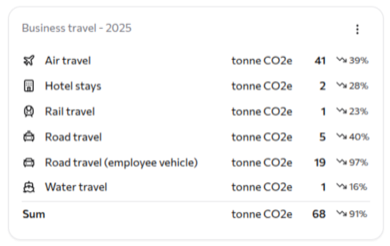
In the app, total Scope 3.6 emissions are displayed in the dashboard under the Emissions by category card and reported in tonnes CO2e per year. More detailed Scope 3.6 emissions data is available under the Business travel card. Emissions are divided into the following categories: air travel, rail travel, road travel, road travel (employee vehicle), water travel and hotel stays (See picture below).
Each category can also be displayed as a detailed card with sub-categories that show the underlying data source, input data used in calculations and the resulting greenhouse gas emissions. The sub-categories follow a consistent naming structure that indicates how the data was collected and calculated:
- from ledger accounts
Spend-based data extracted from general ledger accounts in the ERP system. - from invoices
Spend-based data extracted from the EMS. - from trip length
Distance-based data extracted from the EMS.
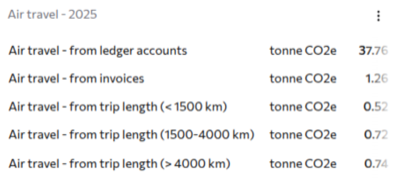
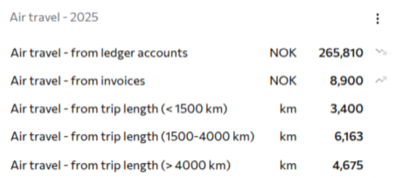
For example, the Air travel card includes the following sub-categories:
- Air travel – from ledger accounts
Amount extracted from ERP system used as input in the calculations, together with the corresponding CO2e emissions - Air travel – from invoices
Amount extracted from the EMS used as input in the calculations, together with the corresponding CO2e emissions. - Air travel – from trip length (< 1500 km)
Flight distance extracted from the EMS for trips shorter than 1,500 km, together with the corresponding CO2e emissions. - Air travel – from trip length (1500–4000 km)
Flight distance extracted from the EMS for trips between 1,500 km and 4,000 km, together with the corresponding CO2e emissions. - Air travel – from trip length (> 4000 km)
Flight distance extracted from the EMS for trips longer than 4,000 km, together with the corresponding CO2e emissions.
The Air travel card shown below displays the input data (amount spent in NOK and distance travelled in km) on the left, and the corresponding emissions (in tonnes CO2e) on the right.
Report
In the report, the monthly breakdown of Scope 3.6 emissions is presented in the Emissions by scope tab and reported in tonnes CO2e. More detailed Scope 3.6 emissions data is available in the Business travel tab. Emissions are presented on a monthly basis and divided into the following categories: air travel, rail travel, road travel, road travel (employee vehicle), water travel and hotel stays.
The Appendix tab contains additional detailed information intended to support auditing, quality assurance, and regulatory purposes. Within the Appendix, each business travel category is further divided into sub-categories. For each sub-category, the following information is provided: category, description, data source, calculation method (spend or activity-based), calculation accuracy (low/medium/high), input unit (for example NOK or km), input value used in calculations and resulting greenhouse gas emissions (tCO2e)
The Appendix tab provides traceability and documentation of the underlying calculations, making it useful for users who require a detailed audit trail of the reported emissions data.