
Scope 3.3: Fuel and energy related activities
Learn how the Greenhouse Gas (GHG) Protocol defines Scope 3.3 emissions, how the protocol recommends calculating them and how they are actually calculated in Climate Reporting
How are Scope 3.3 emissions defined in the GHG Protocol?
Scope 3.3 covers emissions related to the extraction, production and transportation of fuels and energy purchased by the reporting company. It does not include emissions from the combustion of fuels or purchased energy consumed by the reporting company because they are already included in Scope 1 and Scope 2.
Scope 1 includes emissions from the combustion of fuels by sources owned or controlled by the reporting company. Scope 2 includes the emissions from the combustion of fuels to generate electricity, steam, heating, and cooling purchased and consumed by the reporting company.
Emissions under Scope 3.3 are broken down into four activities:
| Activity | Description | Relevant for |
|---|---|---|
| Upstream emissions of purchased fuels | Extraction, production, and transportation of fuels consumed by the reporting company. Examples include coal mining, gasoline refining, etc. | Companies that use purchased fuels. |
| Upstream emissions of purchased energy generated from fuels | Extraction, production, and transportation of fuels consumed in the generation of electricity, steam, heating, and cooling that is consumed by the reporting company. Examples include mining of coal, refining of fuels. | Companies that use purchased electricity, steam, heating, and cooling. |
| Transmission and distribution (T&D) losses | Generation (upstream activities and combustion) of electricity, steam, heating, and cooling that is consumed (i.e., lost) in a T&D system. | Companies that use purchased electricity, steam, heating, and cooling. |
| Generation of purchased electricity that is sold to end users | Generation (upstream activities and combustion) of electricity, steam, heating, and cooling that is purchased by the reporting company and sold to end users – reported by utility company or energy retailer. | Utility companies and energy retailers. |
How does the GHG Protocol recommend calculating Scope 3.3 emissions?
Companies may use either of the following methods to calculate Scope 3.3 emissions from upstream emissions of purchased energy and T&D losses:
- Supplier-specific method
- This method involves multiplying physical activity data (consumption of energy in kWh, liters or other relevant units) by data provided directly by the supplier on upstream emission (extraction, production and transportation) and T&D grid loss rates of energy consumed.
- Possible activity data includes:
- Quantity and type of fuel consumed
- Quantity of electricity, steam, heating and cooling purchased and consumed, broken down by supplier, grid region, or country
- Possible data sources can include:
- Collecting data from procurement department OR
- Collecting data from energy suppliers OR
- Energy bills/meters OR
- Ledger accounts tracking energy expenditure
- Emission factors:
- Fuel-supplier specific emission factors for extraction, production, and transportation of fuels per unit of fuel consumed (e.g., kg CO2e/kWh), by fuel type and country/region
- Utility-specific emission factors for extraction, production and transportation of fuels consumed per MWh of electricity, steam, heating, or cooling generated
- Utility-specific T&D loss rate, specific to the grid where energy is generated and consumed.
- Average-data method
- This method involves multiplying physical activity data (consumption of energy in kWh, liters or other relevant units) by relevant industry-average emission factors
- Possible activity data includes:
- Quantity and type of fuel consumed
- Quantity of electricity, steam, heating and cooling purchased and consumed, broken down by supplier, grid region, or country
- Possible data sources can include:
- Collecting data from procurement department OR
- Collecting data from energy suppliers OR
- Energy bills/meters OR
- Ledger accounts tracking energy expenditure
- Emission factors needed:
- Average emission factors for upstream emissions per unit of consumption (e.g., kg CO2e/kWh)
- Grid-region, country, or regional emission factors for extraction, production, and transportation of fuels per unit of consumption (e.g., kg CO2e/kWh) of electricity, steam, heating, or cooling generated
- Country, regional or global average T&D loss rate
How are Scope 3.3 emissions calculated in Climate Reporting?
As per the GHG Protocol, Scope 3.3 emissions should be calculated using either the supplier-specific or average-data method. Climate Reporting uses the average-data method, which involves collecting activity data (fuel consumption, distance travelled, fuel spend) and applying relevant upstream industry-average emission factors to determine emissions.
Activity data is collected in Climate Reporting using one of the following approaches:
- Energy use from direct measurement: Directly measured energy consumption data in physical units (e.g., liters, or m³ of fuel consumed). This data must be manually entered by the user. (High accuracy)
- Energy use from energy spend: If directly measured energy consumption data is unavailable, energy use is estimated from spending on energy (using energy bills or financial accounts). To estimate fuel use from fuel spend, the total spending on each fuel type is divided by the average fuel price of that fuel. (Medium accuracy)
Important to note that the resulting energy use estimates are also used to calculate Scope 1 and Scope 2 emissions. Consequently, energy consumption directly affects Scope 1, Scope 2, and Scope 3.3 emissions.
How are Scope 3.3 emissions displayed in Climate Reporting?
App
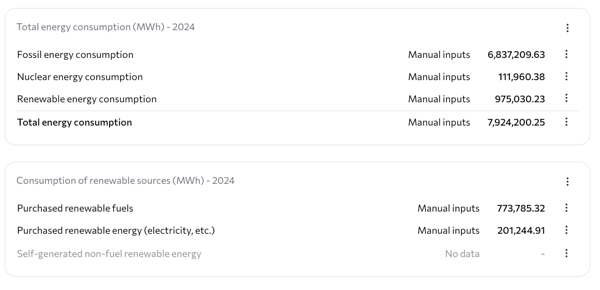
In the app, total Scope 3.3 emissions are displayed in the dashboard under the Emissions by category card and reported in tonnes CO2e per year. More detailed Scope 3.3 emissions data is currently unavailable, but it is possible to view detailed consumption data through the energy consumption cards (shown below).
Report
In the report, the monthly breakdown of Scope 3.3 emissions is presented in the “Emissions by Scope” tab and reported in tonnes CO2e. Additional detailed Scope 3.3 emissions data is currently under development and will be made available in a future release.
In the meantime, it is possible to view energy consumption of different sources. Consumption of all energy sources can be viewed under the “Energy consumption by source” tab. The “Energy consumption” tab shows an aggregated breakdown of consumption from different sources in accordance with the energy disclosure requirement (E1-5) mandated by the ESRS.